
Adaptation and Loss and Damage Nexus
The Adaptation project was created to investigate values, practices, and synergies at the nexus of adaptation and loss and damage. It aims to ensure sustainable development by meeting communities where they are and supporting them on the ground. The group serves as a dedicated space for diverse stakeholders: researchers, policymakers, UNFCCC negotiators, scientists, NGOs, funders, and affected communities, to collaborate on solutions, align strategies, and raise finance across the full spectrum from adaptation to loss and damage.
Research is central to our work, we aim to identify hard and soft limits to adaptation, document community-led practices, and translate evidence into actionable knowledge. Through active policy tracking at UNFCCC events (COPs, SB sessions, and Adaptation Committee meetings), we monitor how loss and damage indicators emerge. By fostering strategic alignment among all stakeholders, we aim to build a new narrative: adaptation and loss and damage are complementary, not competing, agendas.
To find out more about the working group please contact: malek@lossanddamagecollaboration.org
Team Members

MALEK ROMDHANE
Malek Romdhane is a climate policy expert, researcher, and UNFCCC youth negotiator on climate adaptation, a Loss and Damage Fellow of the New Generation Program, a graduate of the UN Geneva Graduate Study Programme on SDGs and Agenda 2030, and currently leads the Adaptation Project within the Loss and Damage Collaboration.
Her research within the Adaptation project investigates the hard and soft limits of adaptation, community-led practices, and the scientific and policy evidence gaps at the intersection of adaptation and loss and damage, with a commitment to translating empirical findings into actionable knowledge for vulnerable communities and ensuring finance for loss and damage projects, driving impact on the ground for affected communities while shaping international policy through active tracking of UNFCCC negotiations and cross‑sectoral alignment between adaptation and loss and damage agendas.

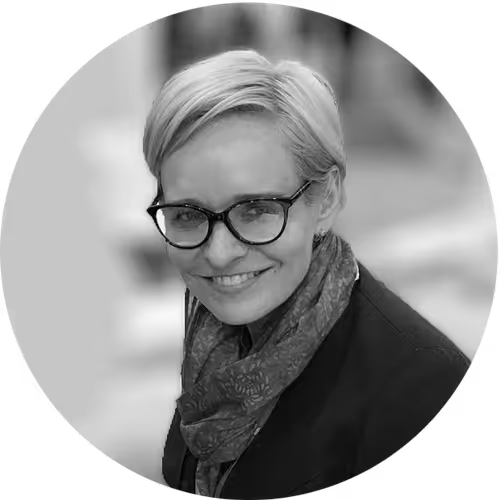
ERIN ROBERTS
Erin (she/her) is a climate policy researcher who has worked on both adaptation and Loss and Damage, with a particular focus on supporting developing countries in the UNFCCC negotiations. She has degrees in biology, international relations and international development with a PhD on the way in which leadership shaped the evolution of Loss and Damage policy in Bangladesh.

Lilian Khalai
Lilian is a Climate Advocacy Coordinator, working at the intersection of parliamentary systems and climate governance at DanChurchAid. She leads global legislative engagement on climate action and convenes high-level parliamentary dialogues on adaptation and Loss and Damage, shaping structured engagement between policymakers, technical experts, and practitioners within international climate governance processes.
Her work spans the design and facilitation of policy processes linking grassroots evidence, climate finance accountability, and institutional decision-making. She has led a Southern-led small grants initiative focused on strengthening locally led climate action and building the resilience of frontline communities through implementation support, alongside coordinating a climate advocacy campaign translating community-generated evidence into structured demands for accountability in climate finance. She previously served as Chair of the Health Cluster of Non-State Actors during the Africa Climate Summit (ACS2), contributing to the elevation of health within UNFCCC-aligned climate governance and broader multilateral negotiations. Across her work, Lilian focuses on strengthening the interface between adaptation, Loss and Damage, and climate finance governance, with emphasis on evidence-to-policy translation and system-level climate response for vulnerable communities.

Ayesha Dinshaw
Ayesha is the Loss and Damage Program Officer at the Climate Justice Resilience Fund. She manages a $6 million portfolio of loss and damage grants that centers the lived experiences of marginalized communities. Based on this portfolio, she supports learning and advocacy at the international level. Prior to working at CJRF, Ayesha was a Manager at the World Resources Institute where she spent 12 years working on research and policy focused on adaptation and resilience.

Alpha Amadou Djalon
Executive Director and Project Manager of AlfaVert, Alpha is a national energy and climate finance expert, and a specialist in climate change (mitigation, adaptation and loss and damage) who bridges mining engineering, local communities development with strategic resilience-building. He has delivered measurable impact as a key performance driver for Guinea’s Green Climate Fund programming, successfully strengthening institutional capacities and streamlining national climate finance frameworks. As a prominent strategist for the New Generation of Negotiators (NGN), he continues to shape global adaptation policy by integrating technical rigor with indigenous knowledge to secure sustainable, large-scale environmental outcomes.